The Impact of Crises on Individuals
A crisis does not strike companies — it strikes the people companies are made of. A story about what really happens to a person in hard times, why fewer than 2% of people see a crisis as an opportunity, and why every crisis is, at its root, a crisis of meaning.
It is easy to think of a crisis in numbers: falling revenue, cancelled contracts, empty diaries. But a crisis does not strike spreadsheets — it strikes people. And organisations, however far automation and digitalisation advance, are still organisations of people, not of computers and robots. The overall energy of a company and all of its further prosperity depend on the capability, resourcefulness and motivation of individuals in difficult moments. That is why the story of any crisis always begins with a single human being, not with a balance sheet.
So what actually happens to that person when the crisis arrives? The changes do not come all at once, nor loudly. More often they creep in quietly, one after another, until they gather into a weight that is hard to name.
Body and mind pay the first bill
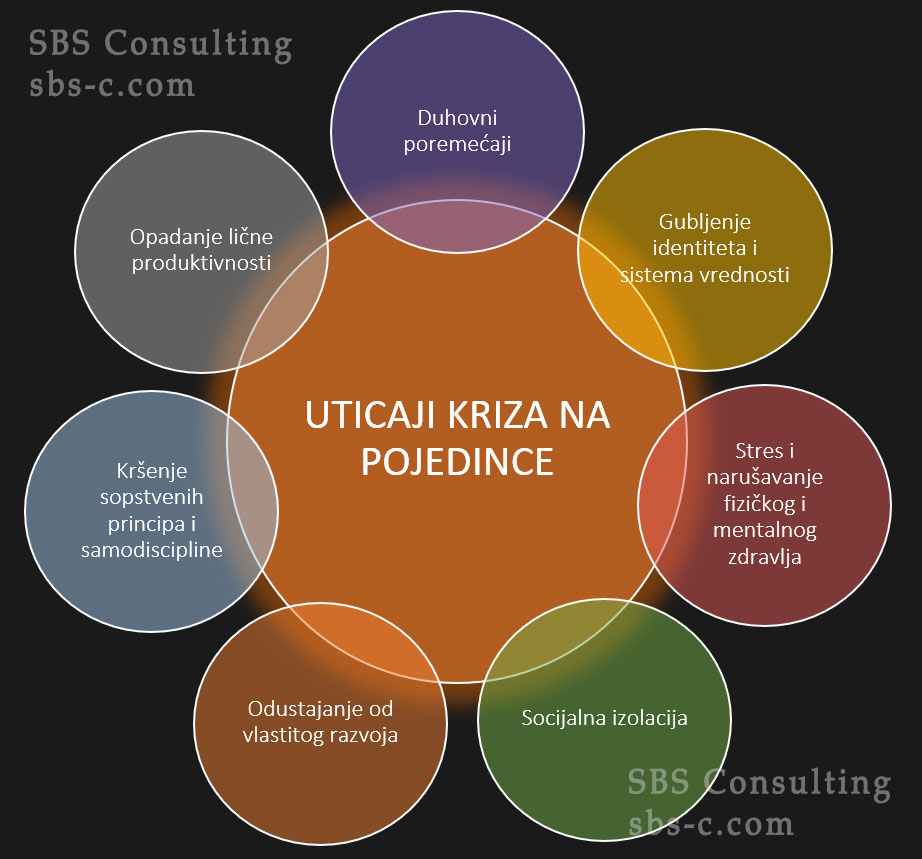
The most sensitive thing gives way first — health. Stress rises, and with it the deterioration of a person’s physical and mental state. In a great number of people it leaves a visible mark: anxiety that will not pass, and a depression that paints every day grey. The body carries what the mind cannot manage to recognise and put into words.
Withdrawal comes alongside it. Economic pressures, health worries and psychological exhaustion push a person into social isolation — and that rarely arrives alone. With it come indifference and despair, that quiet giving-up on the ties that once kept us afloat.
Giving up on oneself
There is one especially insidious phenomenon: in a crisis, a person sacrifices their own development first. Further learning, training, growth — all of it is postponed for some other, “happier times” which, of course, rarely arrive on their own. What ought to have been an investment in the future becomes the first thing to fall off the list.
Then inner discipline gives way too. Under conditions of sheer survival and everyday stress it is easy to breach one’s own principles — and most people do exactly that: they abandon their positive commitments and healthy habits, not because they no longer value them, but because they can barely hold the day together. The struggle to endure has a way of devouring everything a person failed to protect.
And when there is no work and passivity grows, personal productivity declines. Not because the person has suddenly become less capable, but because the crisis has cut them out of the rhythm in which they were useful to themselves and to others.
When meaning is lost
The deepest disturbances are neither bodily nor material — they are spiritual, existential. In a crisis the purpose and meaning of life are lost. The line between good and evil blurs and gives way to a kind of “tolerance” towards things we would once have plainly rejected. Harmony with oneself and one’s surroundings breaks apart, and inner peace and serenity slip away.
At the end of that sequence stands the hardest thing of all: the loss of identity and the erosion of the value system, as a consequence of the very decline in the conditions of existence. When the foundations of a life are shaken, so too is the picture a person holds of who they are and what they stand for.
A crisis at the root — a crisis of meaning
If all these phenomena are set side by side, something easy to overlook comes into view while we are watching only the consequences. All crises — apart from natural disasters — are essentially caused by a crisis of spirituality, a crisis of identity, a crisis of the value system and a crisis of an unhealthy way of life. This is not moralising; it is diagnosis.
From that root the worst of it grows as well. Greed, destruction and the infliction of harm on other people are, for the most part, consequences of precisely these crises — and that in those who run the global and local centres of power. But this drama does not play out only on the grand stage. Beyond wider social crises, the same processes appear as isolated cases, at the level of each individual, in entirely ordinary lives.
Why help is the rule, not the exception
There is one figure that changes the whole perspective: fewer than 2% of people experience a crisis as an opportunity. This means that the rare ability to draw a chance out of hardship is not the norm — it is the exception. For everyone else, which is to say almost all of us, a crisis is above all a weight to be carried, not a door that opens.
Hence a simple but important conclusion: people, generally speaking, need help to cope with and survive the onslaught of difficult times. Not because they are weak, but because that is human nature — and because an organisation that understands this protects the most valuable thing it has: the very people of whom it is made.
SBS team — comprehensive business consulting and training.