The Social Intelligence Profile (CCSS)
Interpreting styles of social interaction through two dimensions — social energy and orientation towards people or tasks — and their application in selecting and placing team members.
Interpreting styles of social interaction
The candidate assessment obtained by applying the instrument for determining the “social intelligence” profile does not represent a comprehensive assessment of personality, but rather a simple way of describing personal preferences related to social interaction. Particular styles of social interaction are based on combining two different dimensions of interaction with people, which relate to:
- The level of “social energy”
- The predominant orientation towards people or towards tasks/results.
The first general dimension — “social energy” refers to impulses or tendencies towards establishing communication, interacting with people or exerting influence over them. Within this dimension we distinguish two broad categories of people.
People who have a high level of social energy usually:
- communicate easily and willingly with other people,
- enter into interaction with people without any internal resistance,
- spend a great deal of time with people,
- like to carry out tasks together with other people,
- are drawn to situations that involve a group of people,
- are drawn to situations that involve strangers,
- are drawn to occupations that entail interaction with other people.
People who have a low level of social energy usually:
- can engage in interaction with others, but these are not the situations they most readily choose,
- are more individualistic,
- prefer a limited degree of interaction,
- prefer to communicate with people they know and around whom they feel comfortable,
- are introverted.
The second general dimension — orientation towards people or towards tasks/results relates to whether you see yourself more as a person focused on the task/result or as a person focused on people, when you are trying to achieve a goal or get something done. Here too we can distinguish two broad categories of people.
People who are task-oriented:
- more often rely on themselves rather than on others,
- operate on a “do it yourself” principle,
- sometimes see the people around them as a hindrance,
- see no reason why they should have to worry about other people’s feelings,
- their catchphrase is “I just want to get my job done”.
People who are oriented towards other people:
- establishing interaction with others is part of their priorities,
- they motivate other people to pursue shared goals,
- they want to collaborate,
- they strive to involve others in the work,
- they strive to motivate other people.
We all use both of these orientations — no one uses exclusively one form. However, many people begin very early in life to gravitate towards one or the other basic orientation, and in many of us one of the extremes in each of these two variations may prevail. On the basis of these observations we can gain an interesting insight into the patterns of our interactions and we can better understand the decisions that other people make in various social situations.
Common ways of interacting
If we link these two dimensions by representing social energy on one axis and focus on tasks/results on the other, we obtain four basic combinations presented as four “windows” in the image below. We can give these four interaction patterns metaphorical names: the “driver”, the “reinforcer”, the “diplomat” and the “loner”.
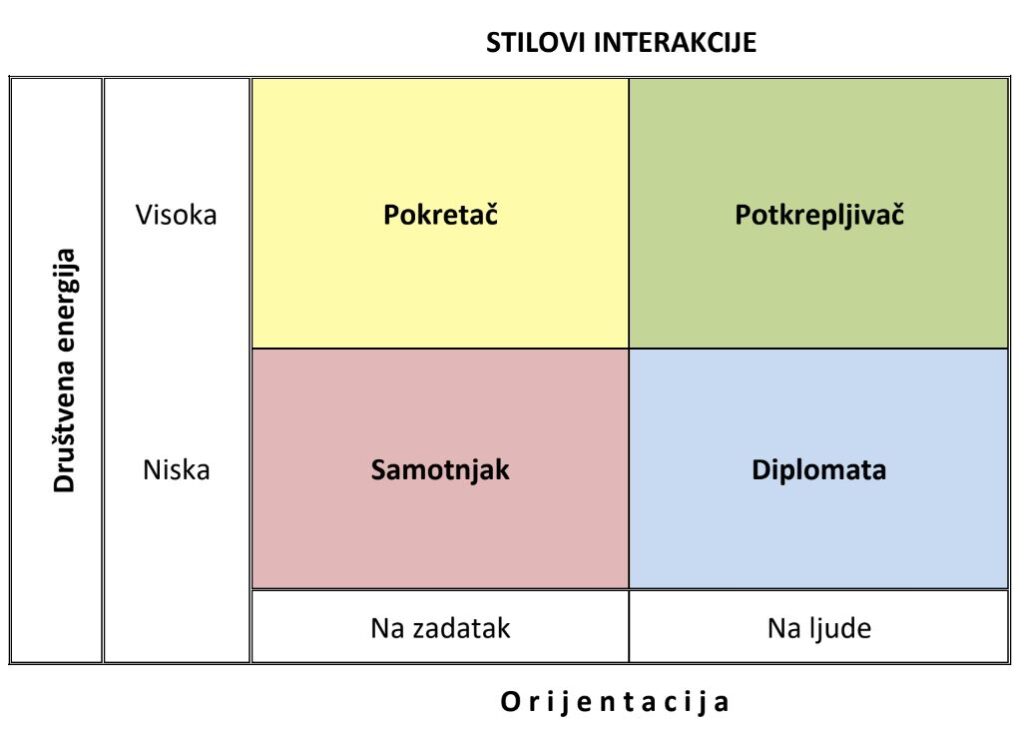
The driver combines a high level of social energy with a strong focus on tasks. People inclined to this kind of interaction take on a leading role in many situations and impose their view of how a job should be done. Drivers may have very well-developed social skills, but they usually operate by directing others towards the shared task in front of them and do not particularly emphasise personal relationships or team spirit. When in a position of formal authority, the driver is usually inclined towards a commanding leadership style. When in the role of a salesperson, they tend to take control of the sales situation. Action films and TV programmes often portray the main hero as precisely this kind of driver.
The reinforcer also displays a high level of social energy, but tends to exert influence over other people through a personal relationship with them. It is typical of the reinforcer to look for ways to bring people together and to motivate them to achieve shared goals. Reinforcers value the personal relationship they have with colleagues and business partners, emphasising collaboration, involving others in the work and developing team spirit. As managers, they often show a tendency towards a more comprehensive, team-based approach to getting things done. When in the role of a salesperson, they tend to “sell themselves” in order to campaign for the product or service they are presenting.
The diplomat uses a “diplomatic pattern of interaction” that manifests itself with a somewhat lower level of social energy. Nonetheless, the diplomat leans towards a focus on people when carrying out work. They command somewhat less, impose themselves less and greatly value collaboration and participation. In the event of conflict or some controversial situation, diplomats can serve as mediators. As managers, they benefit from close working relationships with their colleagues, although they do not always use meetings and team activities as often as those with a high level of social energy do. When in the role of a salesperson, diplomats look, whenever possible, to build long-term relationships with their customers or clients and to use these established relationships to get the job done.
The loner combines a low level of social energy with a great focus on the task. Many loners can often communicate well with others, but they tend to rely only on themselves. Loners feel more fatigue from contact with other people than is the case for people of other interaction patterns. They seek to withdraw into their privacy after intense social activities. As managers, they tend to direct their attention to the work itself and often view problems among staff as a hindrance to the work. They avoid teamwork and prefer to work with individuals and to solve problems as they arise. When in the role of a salesperson, they tend to emphasise practical arguments in the sales situation, such as the advantages of the product, various ways of increasing the value of the product, and the superiority of their product compared with the competition’s offering.
The social intelligence profile plays a significant role in the selection and placement of team members. Different jobs and organisational positions require different social characteristics. We can easily conclude that jobs of the “independent officer for …” type suit the profile of a loner rather than a driver. By the same principle, a leader should be predominantly a driver and a reinforcer and least of all a loner. For a diplomatic service we need a person with a dominant diplomat profile, and so on. If particular combinations of social interaction styles are required, we can likewise recognise this in the profile of a specific person.
CCSS and emotional intelligence
See also the article CCSS and emotional intelligence for broader context on how measurable social and emotional traits are used in selection.
SBS team — comprehensive business consulting and training.