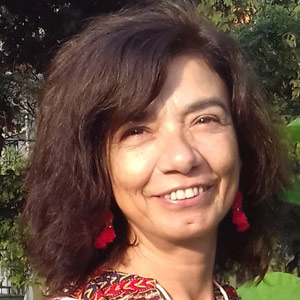
Lisete Costa graduated from the "Instituto Superior de Serviço Social" in the city of Coimbra (1985/89) in the department of Social Work. She completed international postgraduate studies in Social Entrepreneurship and Territorial Development at the "Instituto Politécnico do Porto" in collaboration with the "Universidade de Vic de Barcelona" and the "Santa Casa da Misericórdia do Porto" (2013/14).
She held the post of technical director at two social work institutions in the Aveiro district (1991/97): the "Fundação Bernardo Barbosa de Quadros", in the town of Sever do Vouga, with a nursery, after-school care and a day centre for the elderly, and the "Obra Social de S. Martinho da Gândara", where she was responsible for opening and running a day-care centre and home-help service for the elderly.
Lisete worked as coordinator and manager of the project "Direitos & Desafios" - an anti-poverty programme (1997/2005), promoted by the association "Associação pelo Prazer de Viver" in collaboration with the municipality of Santa Maria da Feira. The project ran in five local communities, largely addressing social problems such as unemployment, low incomes, school dropout, single-parent families and so on.
In the municipality of Santa Maria da Feira she held the post of coordinator of social development projects within the following projects: Habitar (To Dwell) - the POEFDS/FSE Medida 5 programme, for developing integrated actions for critical population groups, the poor and the socially isolated in seven local communities; Riscos e Traços – the "Being a Child" programme, aimed at promoting the social inclusion of young people from at-risk groups through social work via the arts, the project running in two local communities. (2005/2007).
Since 2008 Lisete has been coordinating social development projects, with an emphasis on using art as an instrument for social inclusion, with public performances at several festivals: Festival Internacional Teatro de Rua Imaginarius - Portugal; Buskers Festival, Serbia; Odin Teatret Festival, Denmark, collaborating with groups of artists of various orientations, such as musicians, theatre directors, film directors, choreographers, visual artists and so on.
Thanks to her rich experience of working with people of different professions, ages, nationalities and social milieus, Lisete joined the CCSS (Comprehensive Candidate Selection System) project in order to translate the instruments into Portuguese and adapt them to specific cultures. Together with Aleksandar Carić she has the role of representative of this methodology for the Portuguese-speaking countries. In her free time Lisete is engaged in reading, recreational stays in nature, making artistic woven rugs from recycled material, as well as other forms of handicraft.
Would you like our help?
Our experts will gladly discuss your challenges — without obligation.